Showing posts with label vietnam travel. Show all posts

Monday, April 14, 2014

5 Tips for Traveling with Children in Vietnam

The tourism industry in Vietnam has grown tremendously since the mid 90s.  Previously thought of as a war torn and inaccessible country, it is now a thriving tourist destination in Southeast Asia.  When traveling in a large group of people with varying ages, interests, and tastes, it can be difficult to plan a cohesive trip that suits everyone.  In Vietnam, you have the opportunity to create a family trip that suits everyone’s needs because it is still relatively cheap to travel here and easy to find activities that the whole family will enjoy.  Here are our top 5 specific Vietnam travel tips for those of you traveling with children.


1. PLAN AN ACTIVITIES BASED TRIP


An easy way to keep you and the kids happy during a trip to Vietnam is to plan activities that are ‘hands-on’, but still appeal to both the younger and older crowd.  Vietnam has many opportunities to do just that.  Here are specific places that the whole family can enjoy doing activities while still relaxing and enjoying the surroundings:


Northern Vietnam – Halong Bay is a great spot for family friendly adventure in Vietnam.  During most cruises in Halong Bay, there are plenty of opportunities to kayak in the bay, swim in the ocean, lay on the beach, go squid fishing or take cooking classes.  Some cruise lines are more family friendly than others.  Bhaya, Au Co, and Indochina Sails have some of the biggest decks, giving your kids plenty of space to run around.  Paloma cruises offers the Paloma Family Cruise, which is a private cruise with a 6-person capacity.  The tour can be more catered to your family’s individual needs if the standard activities don’t appeal to you.  Some cruises also have adjoining cabins with a connecting door so you can stay accessible to your kids – Jasmine cruises, Paloma cruises, and Starlight cruises are some of the companies that offer adjoining cabins.


Kayaking and squid fishing are just two activities in Halong Bay that are a lot of fun for kids.


Kayaking and squid fishing are just two activities in Halong Bay that are a lot of fun for kids.


Hanoi, being the capital of Vietnam, has many museums and landmarks that you can visit.  If that gets a bit dry for some members of your family, you can take a trip to the Bat Trang pottery village where everyone in the family can paint a piece to take home.  Your kids might also like “toy street” in Hanoi, located on Luong Van Can street.  If you want to enjoy some open space, the parks near Hoan Kiem lake are usually not too crowded and there is plenty of room for kids to run around.


Toy Street in Hanoi is an interesting place to see with kids... kind of like a Southeast Asian version of Toys


Toy Street in Hanoi is an interesting place to see with kids… kind of like a Southeast Asian version of Toys’R’Us!


Central Vietnam – The culture and environment in central Vietnam can be quite diverse from city to city.  Along the coast, you will have many opportunities to enjoy water sports.  Nha Trang is famous for scuba diving and Mui Ne is known for windsurfing and parasailing.  If your family enjoys water sports, we recommend visiting these destinations.  Nha Trang also has the Vinpearl amusement park which can be a fun activity to enjoy as a family.  To get to the park, you take an impressive gondola ride, which is one of the longest gondola rides over water in the world.  In contrast to Nha Trang and Mui Ne, Hoi An is a much more relaxed town and is a place to experience a different city vibe in Vietnam.  That being said, it is a very touristy town (and therefore, very tourist friendly) so if you and your family need a break from the hustle and bustle of life in Vietnam, Hoi An is a great place to visit.  Visiting the countryside near Hoi An is also a great option and many tours offer the opportunity to float down canals in small bamboo fishing boats.  You can also engage in some cultural activities like taking lantern making classes or taking a bike tour to the surrounding villages.


Southern Vietnam – One of the biggest appeals of Ho Chi Minh City is the bustling and chaotic nature of the city.  If you want to take some time away from the chaos, we recommend visiting Dam Sen Water Park or Suoi Tien Amusement Park.  Both places have plenty of rides, attractions, and activities geared towards children and is a great way to keep them active during your vacation.  Dam Sen Water Park is, as the name states, an aquatic themed park with lots of themed water slides and pools for kids to play.  It is not too far away from the centre of town and the admission to the park is based on height.  Suoi Tien Amusement Park is a Buddha themed amusement park which may seem strange but is a lot of fun for kids.  Besides the rides and activities, they have shows, go kart rides and boat rides.  This amusement park is about 30 minutes outside of town.


The Dam Sen Water Park and Suoi Tien Amusement Park in Saigon are a fun way to spend an afternoon with kids. (The elephants are not real).


The Dam Sen Water Park and Suoi Tien Amusement Park in Saigon are a fun way to spend an afternoon with kids. (The elephants are not real).


The Mekong Delta is also a nice family friendly destination.  Most tours in the delta are hands-on and engaging for young kids because they entail canoe trips down the backwaters, visits to rice paper factories, and visits to fruit candy manufacturing shops.  Large tour companies with multiple groups of people on the same tour can get very ho-hum for kids.  The itinerary is more rigid and not all activities may appeal to your children.  Instead, we recommend private tours through Water Buffalo Tours.  Or, you can even go to Mekong Delta and Cu Chi Tunnels through Saigon River Express, where you travel by speed boat, which can be a fun experience for your kids.


2.  STAY SAFE


It is well known that the lifestyle in many parts of Vietnam is chaotic, to say the least.  Here are some tips on how to stay safe with young children in the city:


Transportation – There are many transportation choices available to you in Vietnam.  When you’re traveling as a family, we highly recommend taking planes or trains from city to city rather than a bus.  Often times, roads in remote stretches are not very developed and can be treacherous.  Also, the journey by bus can be very long because buses tend to travel quite slow, and the long and bumpy ride can be very frustrating for children.  Fortunately, most cities, even small ones, have airports so very few places in Vietnam are inaccessible by plane.  As for overnight trains, they are also quite safe.  If you are a family of more than 4, you will have to split between two cabins as one cabin only holds 4 people.  Within cities, we recommend taking taxis or cars for longer distances rather than bikes or cyclos.  You should especially exercise caution when deciding whether to hire a cyclo in Saigon, though there are safe to hire in Hoi An and other cities in the North.  It seems like a very quaint way to see the downtown area of Saigon, but cyclos have been confined to smaller areas of the city recently and that has made many drivers more desperate and aggressive.  In fact, there have been reports of cyclo drivers threatening the safety of tourists and this is not a situation that you want to be in, especially with children.


Crossing the Road – Crossing the road in Vietnam is a bit of an art.  It may be alarming at first, but the best thing you can do is prepare your kids.  They may be used to wandering around on the side of the road at home, but many roads here don’t have side walks and wandering can have grave consequences.  Make sure that they walk between the adults, and all of you cross in a straight line.  It is usually easier for drivers to navigate that way.  Be alert and cautious, yet definitive, in your movements and you all should be just fine.


Local children crossing the road in Saigon, although we recommend that they have adults on either side of them.


Local children crossing the road in Saigon, although we recommend that they have adults on either side of them.


Interacting with Locals – Vietnamese people are fascinated by kids, foreign kids in particular.  They show their affection towards kids very freely so your kids will not only get treated really well here, they will also be touched, prodded, hugged, played with, and generally be adored.  Don’t be alarmed if this happens to you as it is very innocent on the locals’ part.  With babies and very young children, you do have to be careful that you carry wipes and clean their hands if too many strangers play with them.  And, make sure that they are not wearing anything valuable that may be easy to snatch.  Even if they are wearing something inexpensive which could mistakenly be taken as a valuable item, leave it off them so they don’t become a target of theft.


Getting Lost – Losing your children in a sea of traffic and people is a parent’s worst nightmare.  Take every precaution to avoid this predicament and keep a piece of paper with them with all the necessary information for them to find their way back to you.  Here are some important phrases you can print out, fill in, and keep with them:
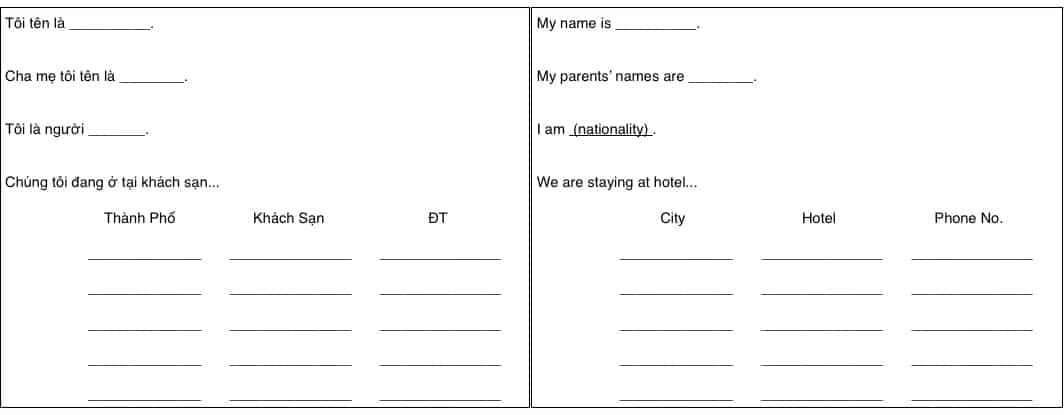

instructions


3.  BE ORGANIZED AND TRAVEL WITH A PLAN


When traveling with kids to Vietnam, it is important to travel with a plan.  It’s very easy to travel here with a relaxed, non-scheduled pace, but that requires a certain amount of flexibility, which is sometimes difficult to have with kids.


Hotels – Definitely book your hotels beforehand, as accommodations fill up quickly, especially during busy season.  Even if you find last minute hotels, be aware that you may not get the amenities that you want.  For instance, if your kids are young enough and you want them in the same room as you, many hotels here only have double beds and little room to put another cot or bed in the room.  Or, if you need a microwave or fridge to store perishable food, that is often difficult to find in hotels here.  Some hotels in busy tourist areas have also have swimming pools, but if these hotels are booked up or outside of your budget, many of them allow outside guests to use their pools for a fee.  In Saigon, The Grand hotel and The Renaissance hotel, both in District 1, allow public access to their pools if your kids want to go for a quick swim to get away from the heat!


Pre-arrange Transport – The standard car taxis in Vietnam are big enough to fit 4 people (but 3 comfortably).  Van taxis can fit more, but it can sometimes be a struggle to find vans.  They are also more expensive.  In any case, with a family, it’s best to arrange transport beforehand through the hotels so that you can be more certain that it will be safe, will fit all of you, and will take you to the right destination without long detours or go-arounds.  The less time you spend sitting in traffic in a stuffy car in Vietnam, the happier you and your family will be.  The rates are usually competitive and you can check online for average taxi rates for whichever city you will be in to compare.  On top of that, taxi scams run amuck in Vietnam so it’s best to avoid the situation altogether.


Check the Weather – The weather in Vietnam is incredibly varied not just by latitude but also by time of year.  It can get quite miserable at certain times of year depending on the time of the year and the last thing you want is to be stuck somewhere that is blazing hot or currently in typhoon season.  Please note that many parts of Vietnam are consistently hot so prepare your kids for what to expect because children can be less resilient to weather that they are not accustomed to.


4. STAY HEALTHY


Short vacations can be easily ruined when children get sick, and changing plans is often difficult when you have less flexibility.  Use these tips to keep your kids happy and healthy during your time in Vietnam:


Include Down Time:  As we mentioned earlier, Vietnam can be a very hectic place.  That, combined with the heat and pollution, can really wear you and your family down.  Vietnam has so many amazing places to see and explore that it can be easy to go overboard and plan every activity imaginable.  But be sure to include some rest periods so that you and your family don’t fall ill.


Food Safety – When traveling with kids to a new country, eating healthy is a big issue.  Check out our previous blog on how to travel in Vietnam without getting sick.  We encourage you to be smart with food choices.  Children can be more susceptible to food borne illnesses so being careful is all the more important when traveling with kids.  Street food can be safe to eat, but you need to be careful where.  Banh mi (Vietnamese sandwich) is usually a safe item that kids can try because it’s mostly bread with whatever fillings you like.  It’s also very hearty so it keeps them full for a longer period of time.  If your child is not too fond of strange fillings, many Banh Mi stands also have processed cheese – you can’t go wrong with bread and cheese!  It may be a good idea to bring non-perishable food items that your kids are familiar with if they decide not to eat local food.  Be careful not to bring anything that will melt because it will turn to mush in the heat here.  In any case, if your kids need a break from Vietnamese food, there are plenty of fast food options like MacDonalds, Burger King and Lotteria where you can find familiar food.


Kids usually love the Vietnamese sandwich (Banh Mi).


Water Safety:  This is another big concern when traveling with children.  First of all, please ensure that your family, and kids especially, have received all their recommended shots before coming to Vietnam.  If you have travelled substantially before or have been exposed to this kind of climate, there is a chance that contaminated water may not bother you.  But children often have lower immune defenses so getting vaccinated for diseases that are transmitted by contaminated water are a must.  Once you are here, be sure to drink bottled water only and even brush teeth with bottled water.  Brushing teeth with tap water may not do a lot of damage if your kids do it accidentally but it’s best not to take the risk.  Ice is also usually safe in Vietnam but use your best judgement when ordering cold drinks.


5. BRING PROTECTION


The elements can be just as big a factor in children becoming ill as food and water, and require just as much attention.  Vietnam can have an extreme climate which can be bothersome without proper preparation.  For a more comprehensive list of what to bring and what not bring to Vietnam, check out our previous blog entry.


Insect Repellent:  We have mentioned before that dengue fever is fairly common in Vietnam, and though it can affect anyone, immunocompromised people and children are more likely to contract this disease.  What’s more, children are less likely to show restraint when scratching mosquito bites so even if they don’t contract dengue, those bites can become infected easily in the hot climate in Vietnam.  Some areas in Vietnam like the Mekong Delta are quite swampy and mosquito ridden, so use strong insect repellent with DEET to avoid any issues and bring anti-itch cream with you.


Hats and Long Sleeves:  Both heat and pollution can cause a lot of body stress for children so keep hydrated, bring a hat and breathable material long sleeves if you plan on spending a lot of time outside such as significant beach time or hiking in the hills.


Medicines:  Vietnam has many long and windy roads and even short distances can be nauseating.  Some foods and smells may also give you nausea, even if they are perfectly safe to eat.  Many people comment that the wafting smell of fish sauce or strange meat is too different for children to handle.  Because of this, we recommend that you pack anti-nausea medication and Pepto Bismol.  Note that although you can find these medications here, they are often marked up significantly and special versions specifically for children can be hard to find.


xotours.vn


5 Tips for Traveling with Children in Vietnam

Saturday, November 23, 2013

Vietnam is a Feast for the Eyes and Other Senses

Vietnam is an edgy but exciting country to explore. Here, vacationers bounce back and forth between noisy cities where more than 500 motor scooters and bikes surround every car, and a bucolic countryside where water buffalo pull farmers on a foot plow through watery rice fields.


20131123-160141.jpg


Centuries of History Shaped the Country American travelers old enough to personally remember the Vietnam war may have mixed feelings at they explore this country, especially when their guides discuss the “American” war, although the conflict ended in 1975. It’s been said that “winners write history” and the first time one sees a memorial honoring the Viet Cong or squirms

through the Cu Chi Tunnels slams that fact home. However, this country was actually at war for thousands of years, first with the Chinese and others in the region, then with the French before the

U.S. Exploring the remnants of the Imperial Era, such as the Temple of Literature in Hanoi and the Citadel in Hue (where American soldiers reportedly found kimono-clad, grey-haired concubines still in residence) offer fascinating insights into the blend of ethnic cultures that make up today’s Vietnam.


Exploring the Major Cities Ho Chi Minh City, which many locals still call Saigon, has more than five million residents and Hanoi has some four million residents. Cars move around the traffic-choked streets by honking incessantly to warn people on motorbikes they are being passed. In both cities much of daily life spills out onto the sidewalk; locals gossip and vendors stand outside the single-car-garage-wide storefronts.


20131123-160325.jpg


The streets are lined with shops, stalls, pushcarts, and vendors with their wares spread out on the pavement, selling everything from soup to live animals, T-shirts, and postage stamps. Many

restaurants are inexpensive but serve superb Vietnamese cuisine, with preparations that are very different than in other Asian countries. There are

many excellent French restaurants, too, the legacy of the French occupation. Seeing Key Sights When you visit Ho Chi Minh City, tour by the lacquerware factory, where the crafts are made by

disabled Vietnamese. The pictures, decorative items and tableware are beautiful and very reasonably priced. It’s an easy half-day trip, partly through the countryside, to the Cu Chi Tunnels, and quite an experience crawling through them.


From Saigon, it’s an easy day trip to the Mekong Delta and a floating market. Visit Hue and Float on the Perfume River Hue, in the middle of the country, was Vietnam’s capital city during the last Imperial dynasty. The colorful Imperial buildings are located in the

Forbidden City, which is inside the wall-encircled ancient Citadel where the Viet Cong holed up during Tet offensive. Take a ride in a Dragon Boat on the Perfume River to visit some of the temples.


Vietnam is a Feast for the Eyes and Other Senses

Thursday, November 21, 2013

A Travel to Van Phong Bay

Van Phong, called Port Dayot by French people, is located in Van Ninh and Ninh Hoa districts. There is a sand hill that is 18km long, situated between the main land and two islets creating a bay with a very beautiful landscape.


20131122-114516.jpg


This beautiful landscape is endowed with wonderful natural sceneries and beaches of fine sand, an ideal temperate climate, surrounded by hills, mo untains and tropical forests. The sea is all the more embellished with colorful coral reefs, vestiges of mangrove forests, rare sea creatures in an ideal environment. These are great potentials for the development of ecological tourism in Van Phong. In the plan toward the year 2010, Vietnam Nation al Administration of Tourism declares Van Phong as “the most important region for tourism development”.


20131122-114524.jpg


There are many forms of water sports and uphill tourism here, including sea diving, water skiing, sail boating, mineral water bathing and hunting. At present, Van Phong is ranked first of the four sea tourist centers by the Sea World Association.

With Vietnam tourism, besides water and corals, the bay has more natural attractions. It is home to magnificent mountains with almost untouched forests and lovely beaches, and it is the habitat for hundreds of species of plants and animals. After exploring the ocean, you can walk along the white sandy beach, climb up the nearby mountain or observe animals in the island’s forest. At night, you can stay in nice bungalows along the beach and eat seafood with Vietnamese.


The weather in Van Phong is warm all the year round and the natural environment is almost intact and unpolluted, which is an ideal place for eco-tourism. Van Phong is in the centre of Southeast Asia, with almost the same distance to capitals of regional countries. This is an advantage to develop tourism because it takes tourists only two hours to travel by plane to the bay.


A Travel to Van Phong Bay

Wednesday, November 20, 2013

Com Hen (mussels rice) - the feature of Hue"s cuisine

The Hue cuisine is well known throughout the country and has indeed enriched the culinary art of Vietnam. As Vietnam’s former imperial capital, the city of Hue has two kinds of cuisine: one for aristocrat and the other for common people. One of the dishes for common ones specially enjoyed by most of the locals and tourists alike is mussel rice.


20131121-115908.jpg


Two main ingredients of this popular food are mussels and cool rice. Mussels after being discharged impurities are boiled and drained off for flesh. The flesh is then stir-fried with Chinese vermicelli, dried bamboo shoots and chopped lean pork.

The broth obtained after boiling the mussels is seasoned with ginger for fragrant taste. Then processed mussels and cool rice are put into a bowl and watered with the broth. There are also such supplement as chilli sauce, red pepper, fish sauce, girdle cake, crushed peanut, roasted sesame, and various raw vegetable to help enhance the flavor of the food.


20131121-115834.jpg


All these ingredients combine together creating the unique sweet and spicy taste for the mussel rice which has now became the local speciality that tourists always hunt for once visiting Hue city.


Com Hen (mussels rice) - the feature of Hue"s cuisine

Sapa - splendid moutainous town

If you want a place of cultural authenticity and natural tranquility, you have found the right place – Sapa


20131121-080928.jpg


Sapa is a mountainous town in Northen Vietnam where you write poem, have your cameras on for most of your time, cheer over a community wine pot, learn to appreciate indigenous culture or just to escape Hanoi heat and city noise. Being one of the most attractive tourism destinations of the country, Sapa is a precious gift that Mother Nature dedicates to Vietnam. Location and history 350km far north-west from Hanoi, Sapa, the capital of Sapa District in Lao Cai Province, lies at the altitude of 1600m.


20131121-080951.jpg


With the temperature ranging

from the lowest of -1oC to the highest of 29oC, Sapa’s climate is moderate and drizzly in summer while chill and foggy in winter. Sapa (or Chapa- the “sandy place”) first appeared inVietnam national map in the late 1880s when theFrench disembarked in highland Tonkin. The first permanent French civilian resident arrived in Sapa in 1909, and by 1920, there were a number of villas being built in this area by prosperous professionals.


Going through many ups and downs, nowadays, Sapa is the prominent holiday destination, favored by both locals and foreign tourists. Sapa – fairy home of ethnic minorities There is nowhere in Vietnam can tourists easily meet the local ethnic minorities like in Sapa. The district is the home of a great diversity of ethnicpeople, including five main groups of Hmong, Yao, Tay, Zay and Xa Pho. They do not live in centerarea but in hamlets scattering on the valleys throughout Sapa District.

Actually, not until the 20th century did a majority of the ethnic people changed to sedentary lifestyle with intensive farming method on sloping terraces, instead of slash-and-burn culture like in the past. Town of Sapa is where ethnic minority people gather, trade or sell their farming products such as rice, corn, fruits, as well as handicrafts and souvenirs to tourists.


20131121-080941.jpg


There is one interesting fact about ethnic minority people in Sapa that besides their dialects, many of them, especially small children, can speak English pretty well with clear pronunciation. Spending time visiting ethnic minorities’ villages, observing their daily’s activities or even living homestay, in order to understand more about their culture is now the top priority of visitors, especially international ones. A trip to Sapa would definitely more meaningful with participatory activities, such as learning to make handicrafts or helping the local with farm work!


20131121-081051.jpg


In case time does not allow, you can always hire a local guide for your trekking routes. Chances are these boys and girls will tell you lovely stories about their traditions, their lives or even ask you to join their family activities. Sapa- challenging for mountainous trekking Sapa is voted to be the best trekking spot in Vietnam, by both natives and foreigners. The whole district is dominated by The Hoang Lien Son mountain range, which also includes Mt. Fan Si Pan- the highest peak in Vietnam and the entire Indochina peninsula with the height of 3143m. Thismount is not only a tough challenge to trekking enthusiasts but also an opportunity to witness the splendid mountainous vista. The scenery of the Sapa region represents a harmonious relationship between the minority people and nature, which can be seen perceptibly in the paddy fields carpeting the rolling lower slopes of the Hoang Lien Mountains.


It was the elements wearing away the underlying rock over thousands of years that created this impressive physical landscape. The geographical location of the area makes it a truly unique place for a rich variety of plants, birds, mammals, amphibians, reptiles and insects, some of them can only be found in northwestern Vietnam. Sapa-thunderstruck local food Sapa’s specialties are another reason attracting more and more tourists travelling to this town. A wide range of sub-tropical vegetables such as white cauliflower, red beet, or chayote are planted here.

There are dishes that will be a must to enjoy for every visitor – boiled chayote consumed with sesame or “lon cap nach”- pig carried under armpit, which are home pigs but are raised in the field or forest. The cool weather of the region makes barbecued meat and fish with mushroom and vegetables the

most preferred street foods in Sapa. People grill corn, sweet potatoes, dumpling, bamboo-tube rice, or even eggs as well.


20131121-081111.jpg


Nevertheless, tourists can try many other local foods like purple sticky rice or “thang co”- horse meat right in Sapa market. More surprisingly, Western restaurants, from Italian

to French ones, can also be found around the center of Sapa, at a very reasonable price


Sapa - splendid moutainous town

Tuesday, November 19, 2013

What does Vietnamese puppets say?

Watching water puppets in the village. We do not know whether water puppets appear in other countries or whether they remain only in Vietnam, but we do know that they continue to spread to gain intimacy with their audience.


20131120-094929.jpg


If you want to see water puppets in their true environment, you must watch them in the cradle where they began, in the open air in a village of the Red River Delta. Two years ago, I had the good fortune to see such a performance in Dao Thuc, a village of two thousand people about 25 kilometers from Hanoi. It was drizzling that day. The pagoda stage rested in the midst of a green rice paddy, with many villagers sitting all around on three sides of a pond. The fourth side was reserved for the stage, which had been set in the water.


The performance was organized to celebrate spring in the village. It was not done by professionals but instead by farmers, who, as members of the village organization, had made their own puppets and had practiced with them. The characters were old and young, large and small, men and women, taking part in activities of ordinary life, including cultivating rice, catching fish, and tending ducks, with everyone laughing when a fox nabbed a duck or when Teu joked.


20131120-094719.jpg

Chu Teu


As I watched the audience, I saw how moved they were at the deep meaning in an artistic profession of ordinary people that dates back 2,000 years. Water puppets as reflection of culture Water puppets are a form of culture from the Red River Delta, an area that is hot and humid. The land is filled with rivers, and every village has a pond or lake that can be used as a theater. The weather must be warm since the performers stand in water for hours. During the time of French colonialism, urban people did not know about water puppets because they were performed only in the countryside and only for local villagers to see.


20131120-094837.jpg


As a result, water-puppet scenery is entirely rural: rice paddies, bamboo gates, fishponds, banyan trees, wells, and village temples. In order to liven the performance, the scenery includes action: cultivating with water buffalo, irrigating, harvesting and winnowing rice, weaving, kids jumping, and swimming fish and frogs. Aside from farmers, there are village workers (sawyers, blacksmiths, and carpenters). All the setting I from within the village, complete with processions dancing unicorns, dragons, turtles, and phoenixes. The stories used are from Vietnamese traditional theater (cheo or tuong) common to the countryside or taken from history (heroes who have resisted invaders). Most likely the water puppets began as a ceremony to pray that the rice crop would have sufficient water. For that reason, the dragon characters are particularly important. Vietnamese water puppet performances now have a lively philosophy that fits the wishes and needs of Red River Delta farmers making their living from wet-rice cultivation. Such farmers must work hard outside the rice paddies, always fighting against floods and foreign invaders. But since farmers love nature and the rice fields’ intimacy with earth and water, the water puppets praise the labor, perseverance, and optimism such a life requires. But there’s no lack of double meaning and satire when criticizing errors.


The script of a water puppet performance prizes labor, the village, and the family. Good and evil are part of the performance, with good bringing happiness, and evil bringing its own lessons. Regarding spiritual life, water puppets incorporate animism and also the influence of many groups. In watching water puppets, one can see the influence of Buddhism, Taoism, and most of all, of Chinese Confucianism mixed with local beliefs without a loss to the local culture. When water puppets are performed in the rice paddies, spectators see that people and spirits are together in one climate of pantheism.


What does Vietnamese puppets say?

Beer Lao - One cold sip to bring your smile

Beer Lao – a premium beer that would combine the mastery of European beer making methods with an ingredient that was ingrained into the culture of Laos, rice.


20131119-214150.jpg


Through curiosity and the sense of exploration the thirst for world beers is accepted and encouraged more than ever. Students taking gap years or professionals opting to take a sabbatical has influenced the taste buds of consumers when they return. For people who are fortunate to experience East Asia, Beerlao has the emotional connotations that will propel you back to the “land of smiles” with one cold sip.


Time magazine has called it Asia’s best local beer. And the brand’s logo adorns everything from patio furniture to street signs.


Beer Lao - One cold sip to bring your smile

Beer Lao - One cold sip to bring your smile

Beer Lao – a premium beer that would combine the mastery of European beer making methods with an ingredient that was ingrained into the culture of

Laos, rice.


20131119-212811.jpg


Through curiosity and the sense of

exploration the thirst for world beers is accepted andencouraged more than ever. Students taking gap years or professionals opting to take a sabbatical has influenced the taste buds of consumers when they return. For people who are fortunate to experience East Asia, Beerlao has the emotional connotations that will propel you back to the “land of smiles” with one cold sip.


Time magazine has called it Asia’s best local beer. And the brand’s logo adorns everything from patio furniture to street signs.


Beer Lao - One cold sip to bring your smile

Monday, November 18, 2013

The Nine Dynastic Urns

The Nine Dynastic Urns


The Nine Dynastic Urns are the nine greatest bronze urns in Vietnam , placed beside Hiển Lâm Pavilion, in front of the Thế Temple . They were cast under Emperor Minh Mang from the end of 1835 to early 1837 with the following features Each urn’s name coresponds to the posthumous title (the title after his death) of the emperors worshipped in Thế Temple


20131119-142744.jpg


For examples, Cao Urn is named after Emperor Thê Tổ Cao (Gia Long), Nhân Urn after Emperor thánh Tổ Nhân (Minh Mạng) , Chương, Anh, Nghị, Tuyên and Thuần Urns after the next Emperors Thiệu Trị, Tự Đức, Kiến Phước, Đồng Khánh and Khải Định respectively. Until 1958 only seven altars stood in Thế Temple together with seven urns. Dụ and Huyền Urns had not been used yet.


20131119-142759.jpg


At first sight, the nine urns rather resemble each other. However, in reality, they all differ in weight, height, leg and handle shapes, and especially the 17 embossed pictures together with notes surrounding the urn, creating altogether 153 images. They depict the typical scenery of Vietnam in the early 19th century from Lạng Sơn to Cà Mau, with traditional patterns of its stars, rivers, mountains, seas and oceans, boats, vehicles, rare forest and sea products, etc. Together with the altars in Thế Temple , the Nine Dynastic Urns were also installed at their current place after being cast. Cao Urn stands alone in the first row in the center. The others stand in a straight line behind, with the shape of each one on the left corresponding to the one on the right, placed symmetrically to the central urn of Cao Urn, with the names Nhân, Chương, Anh, Nghị, Thuần, Tuyên, Dũ and Huyền. This set of Nine Dynastic Urns is a rare and precious cultural heritage, which is well-preserved in nearly perfect condition, upholding forever the legacy of a dynasty that ruled when Vietnam was unified and strong.


The Nine Dynastic Urns

10 reasons why all men should travel

A right trip can be one of the greatest experiences in a man’s life. It’s an attractive big world waiting to be explored. As men, we’re thrilled by the unknown.

If you’re still reserved, we now have 10 reasons why all men should travel


1. To see the world differently


20131119-111246.jpg


Some of the biggest rewards from travel are felt once you return home. For better or worse, sitting back and thinking about your trip or looking back over your pictures will give you new perspective on the whole world, including the little part of it you call home.


2. To be self confident.


20131119-111502.jpg


There are tons of opportunities while traveling to see what you’re made of. It could be as simple as trying to find your hotel in a town where you can’t read or speak the language.

One of the hardest parts of traveling, and one of its biggest rewards, is the payoff of launching yourself into new situations and forcing yourself to adapt.


3. To appreciate your hometown


20131119-111551.jpg


In seeing all the amazing things in the world, you might find yourself craving the one thing you had all

along – home. Spending time away from your everyday life can actually make you appreciate what you have even more.


4. To make you more interesting


20131119-111650.jpg


Traveling can definitely help you tell better stories as long as you don’t come across like a braggart. Being well traveled makes you more cultured, making you more interesting as a result. The well-traveled person tells better stories, draws more connections and even knows more interesting toasts than the man who stays at home.


5. To challenge yourself


20131119-111934.jpg


there are always lots of unanswered

questions when travelling.

Whether it’s a worry about where you’ll stay or how you’ll communicate if you don’t speak the language, or even a good-old-fashioned fear of flying, travel will reward you richly for overcoming challenges.


6. To achieve a big goal


To pull off a trip to someplace you’ve always wanted to go is a large, complicated goal that will teach you to be persistent and self-reliant in all areas of your life.

(Ex: If your dream vacation is to visit another country, accomplishing that goal will take hard work)


7. To buy some sweet gear


20131119-112457.jpg


All men love an excuse to buy new gear. Picking out the perfect tent, backpack, digital camera, GPS device, tough luggage, or tiny netbook can get us amped up for our trip. The joy of preparing for your trip is also an exciting experience


8. To think on your feet


20131119-112558.jpg


At some point during your trip, something’s going to vary from your plan, that’s when you have to think on your feet. Traveling challenges you to be creative and flexible if you’re really going to enjoy yourself.


9. To meet new people


20131119-112608.jpg


You can run into people from all walks of life, including ones very different from your own. Travel can put you in contact with types of people you might never meet in your daily life, and the stories and perspectives are usually fascinating.


10. To eat new food


20131119-112851.jpg


No matter where your travels take you, some things will always be constant, such as food. You have to

eat, and that you have the opportunity to dig into the local cuisine at least three times a day. That means lots of new eating and drinking experiences; great beers and wines go hand in hand with traveling. In some cases, traveling will expose you to wonderful new foods and, other times, you’ll be eating old favorites, but with authentic flavors.

Finally, many regional cuisines are based around local ingredients, so you’ll be enjoying foods at the peak of their freshness


10 reasons why all men should travel